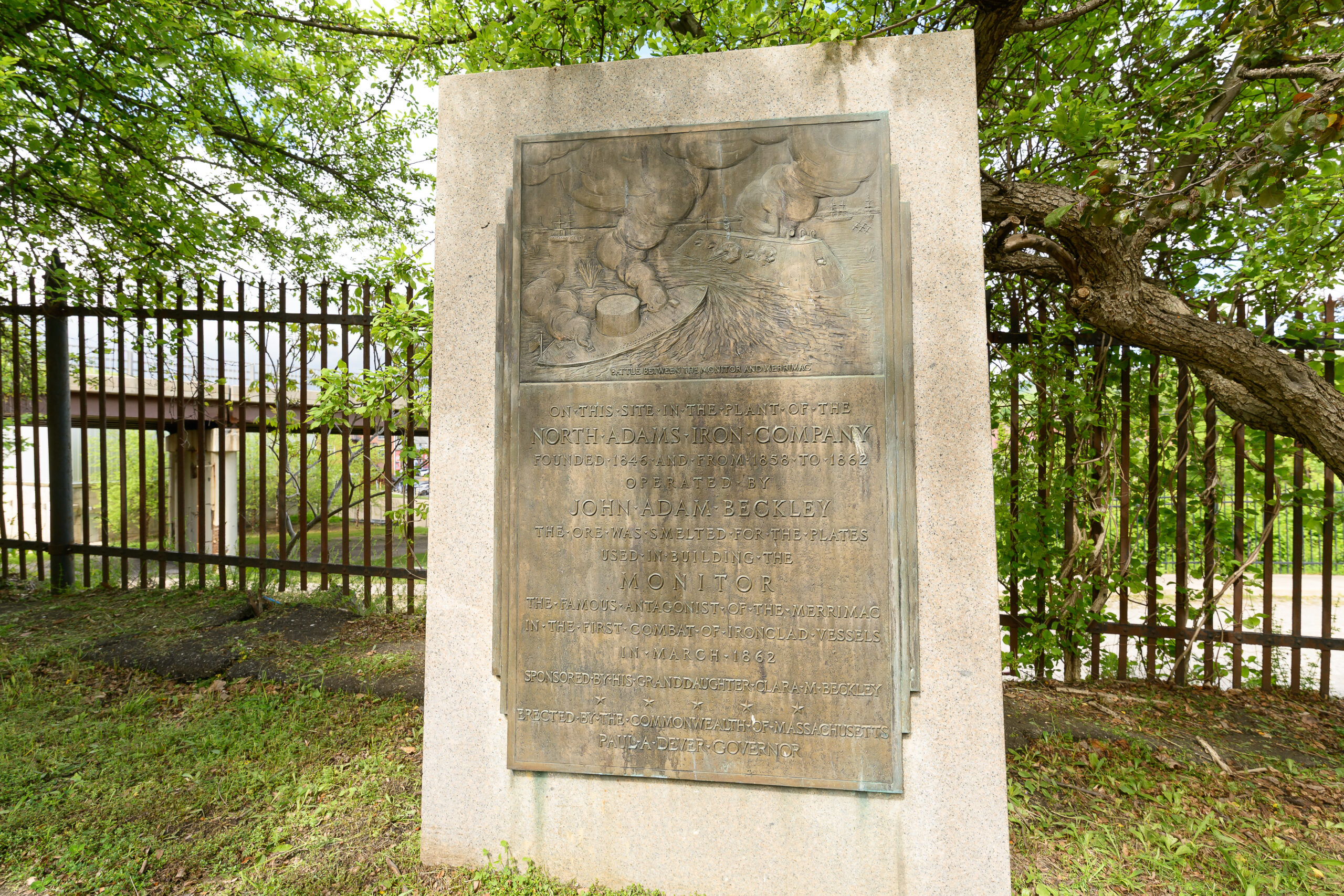
Few people know that North Adams was involved in the first battle of ironclad ships during America’s Civil War. A local blast furnace near Main Street smelted ore from area mines and delivered the raw iron to a foundry in New York where it was rolled into iron plates for use to protect the Union’s first ironclad warship, the USS Monitor.
The North Adams Iron Company opened in 1846 and produced five tons of pig iron per day. After hard times, it closed and then reopened under new ownership in 1858 when it was purchased by John Beckley.
The Civil War revived the ailing company when it was contracted to furnish iron for the construction of warships. As part of the contract, the Iron Company supplied the smelted ore for the USS Monitor. Not long afterwards, while fulfilling other government contracts, the Works caught fire, was destroyed, and never rebuilt.
Confederate forces, ahead of the Union’s efforts to build an iron clad warship, had already built an ironclad ship from the burnt hulk of the USS Merrimack that had been scuttled by Union forces. Once the ship was repaired and armored, it was rechristened the CSS Virginia.
Not long after its launching on March 8, 1862, the CSS Virginia assaulted and damaged or sank a number of wooden Union ships serving blockading force.
The very next day on March 9, 1862, the CSS Virginia was confronted by the Union’s ironclad USS Monitor, which had been rushed to the area from New York. A four-hour battle ensued with little damage to either side.
While battle was considered a draw, it signaled the advent of iron ships and the beginning of the end for wooden ones.
Sadly, the USS Monitor sank nine months later, in 240 feet of water, while being towed in rough seas off Cape Hatteras, losing sixteen of its sixty-two-sailors. The site is now a national maritime sanctuary. The Confederates, in response to advancing Union forces, scuttled and blew up their ironclad with gunpowder during the evacuation of Norfolk, VA.
Note: Although renamed, the CSS Virginia, the Confederate’s ironclad, is often referred to by its original name Merrimack.
To acknowledge the Iron Works contribution, John Beckley’s granddaughter successfully petitioned the government to dedicate a monument on the iron works site in December 1951.
The local monument has a bronze bas relief plaque attached to a 5000-pound, seven-foot high, one-foot thick pink granite stone. The relief depicts the battle between the Monitor and the Merrimac and commemorates the production of the ore that went into the Monitor’s steel cladding.
It’s Interesting to note that Beckley’s ancestors were also involved in making the iron chain that stretched across the Hudson River at West Point to keep the British from sailing up the river during the Revolutionary War. The Beckley’s also produced cannons for the American patriots.
Photo Credit: Dan Morgan Photography